


YOUR EVERY ORIENTALIST DREAM, Our Problem with Belly Dancing (and Women’s Bodies, in General)
Dernière mise à jour : 13 déc. 2025
Tracing the Fantasy: Where the Myth Began and Why It Still Matters
Let’s take a little step back: once, “belly” dancing wasn’t about precision or skill. It was spiritual communion. Women gathered in intimate circles, moving to connect with their bodies, honor fertility and birth, and invoke ancestral heritage through motion. No extravagant costumes required. No formal training necessary. Just raw, spontaneous expression.

In the Levant, women moved at weddings, in courtyards, at the heart of village life. Every step carried a story: a pulse of joy, a faith in living, a testament to resilience.
As this language of movement traveled westward, it gathered new textures. Across North Africa, the tradition unfurled with its own inflections: moving through local rhythms and folkloric histories, each region imprinting its own palette and dialect onto this shared alphabet of the body.
In Egypt’s raqs baladi tradition, the same spirit surfaced almost organically, with bursts of energy in female-only spaces, where technique yielded to something more instinctive: celebrating the body as sacred ground. You danced because the music spoke your truth. You danced because it honored your story. The setting didn’t matter; be it private homes, social gatherings, or anywhere women came together.
What mattered was the why: each woman bringing a personal voice into a communal tradition, exploring femininity on her own terms, in her own way. This was dance as bond, as birthright, as breathing.

Fast forward to today, and the perception of belly dancing looks very different. Everything you think you know about it is, at best, slightly off.
“Belly Dancing”? A Colonial Label
Let’s start with the term itself. “Belly dancing”? A Western colonial label slapped onto centuries of cultural practice. And this is precisely where objectification enters the chat: reducing an entire dance tradition to a single body part while erasing the name that actually carries its origin. Neat trick, that.
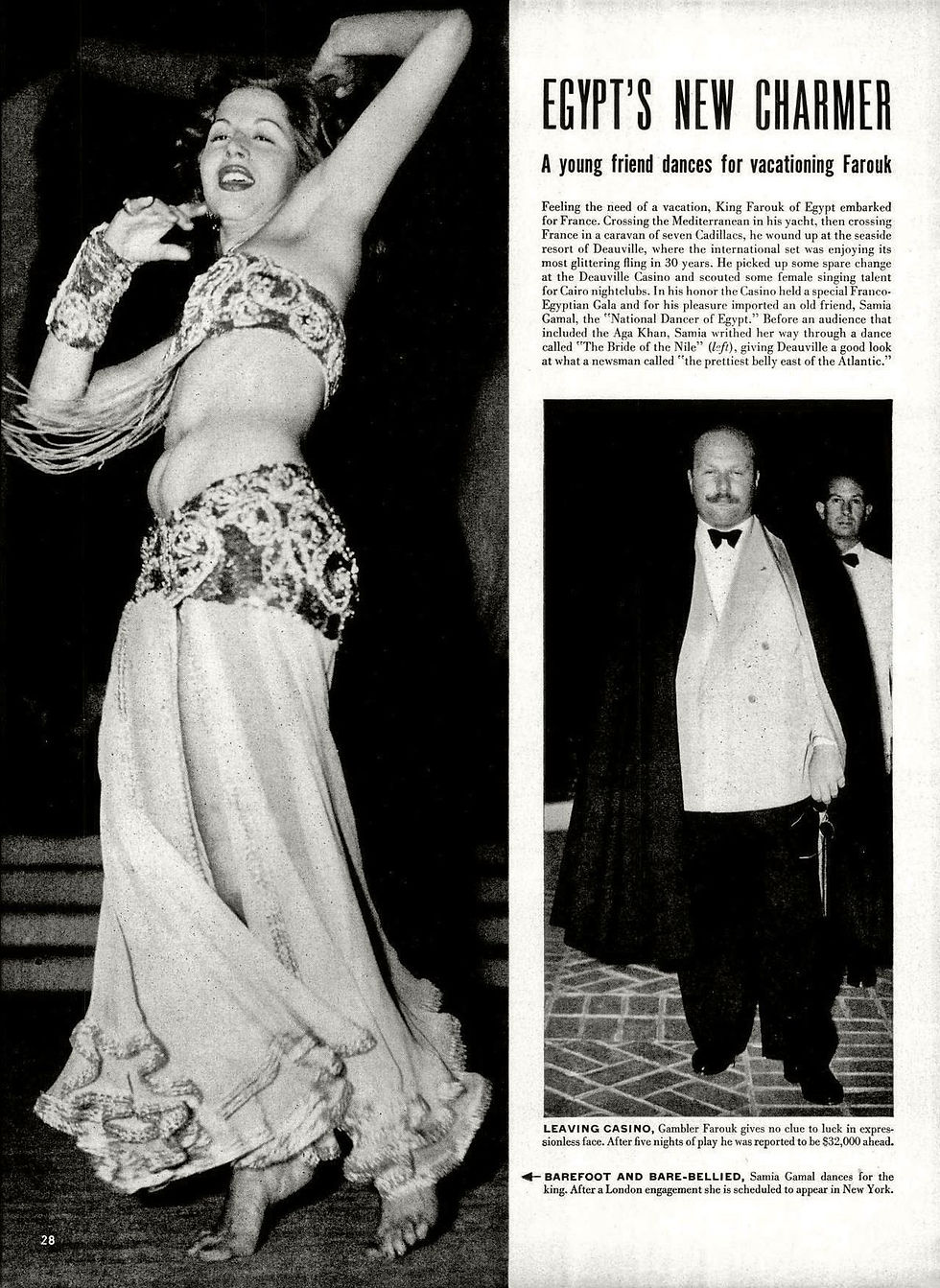
So what about those TikTok videos? You know the ones: influencers dancing on some “Arabic bridge” to Beyoncé’s Beautiful Liar. Flashy outfits, tight routines, all about the hips. You probably think: “Oh, so it’s short, flashy, sexy, and I need a perfect body to even try it.” Bingo! Exactly what the algorithm wants you to believe.
The algorithm doesn’t care about music or culture. It wants you hooked. It gives you a shimmy, a shake, something easy to mimic. The goal isn’t sharing tradition. The goal is viral reach. And congratulations, you just signed up for the ride.
Western Fantasy, 2025: From Algorithms to Empire
But this isn't just about social media; it’s the latest iteration of a much older story. The seeds of this distortion were planted over a century ago, and understanding that history helps us see why today's TikTok trends feel so familiar and so rehearsed.
The question remains: How does Western intervention continue to repackage this art form as Oriental fantasy?
Edward Said already had something to say on the matter. In Orientalism, the Palestinian theorist described it as:
“The corporate institution for dealing with the Orient, dealing with it by making statements about it, authorizing views of it, describing it, by teaching it, settling it, ruling over it.”
Translation: the West is monetizing and reshaping Eastern identity to suit its own desires.
The kicker? Nothing has changed. If anything, it’s amplified by a theatrical stage where European colonial anxieties and power dynamics still dictate the mainstream narrative. The world imagines geography through a European lens, patriarchy benefits, and Arab women pay the price, as they are stripped of both cultural authority and agency over an art form created by and for them.
“Your Every Orientalist Dream”
“Sorry, should I not scream? I forgot to be your every orientalist dream Jinnee in a bottle, belly dancer, harem girl, soft-spoken Arab woman Yes, master, no master.”
Poet Rafeef Ziadah, in Shades of Anger, crystallized the violence of these limiting stereotypes with sarcasm. Who else still bears the cost of the fantasy imposed on Arab women?
Scroll through footage from festivals in Egypt and across the Arab world today, and here’s the twist: most featured dancers aren’t native. They’re either Brazilian, Russian, Ukrainian, American, or basically from anywhere else in the whole globe… Just rarely Arab. At Cairo's annual Ahlan Wa Sahlan festival, for instance, most of the marquee performers aren’t Egyptian at all, but rather dancers flown in from Eastern Europe or South America, staged before audiences who’ve crossed continents in search of an “authentic” experience curated largely by non-Arabs. The irony is staggering.
How can you sell heartbreak, betrayal, or longing in a dance when your biggest concern is knowing the choreography by heart?
Rewriting the Story from the Inside
Enter Sarah Safi Harb: Lebanese dance teacher, Netherlands resident, and a walking conversation between East and West.
In Sowt Media’s Loosely Adapted podcast series (Not the Girl They Wished For), Sarah traces her journey from a girl who gazed at this art with longing but never dared mention it as a serious pursuit, to a dance teacher who simply owns it.
On stereotypical imagery:
“I want to select this image, press ‘all,’ and delete.”
On terminology:
“My mission is to remove this word [ref. belly dancing] and introduce a new one, at least something more original.”
In her classes:
“You’re not coming here to learn a dance. During this hour, you’re entering the space of the Middle East.”
She calls out cultural appropriation’s pick-and-choose mentality, and the refusal to explore all facets of a culture, from joy to longing to sorrow.
“You don’t want the realness. Want to appreciate this culture? Take the whole package.”
Sarah dismantles misconceptions of “female availability” and the notion that native women exist for consumption. As she puts it:
“It’s medicine, it’s connection, it’s like prayer.”
The shift is subtle but real: increasingly, diaspora members are joining her classes out of longing and to reconnect with what was always theirs. Through her classes, Sarah Safi Harb brings a lineage back to life, reclaims a culture, and gives women of all backgrounds a powerful, living art form that lets them fully own who they are.
This isn't about erasing the contributions of non-Arab dancers who approach this art with respect, dedication, and genuine curiosity. It's about asking: who gets to define the narrative? And whose voices have been silenced in the process?
Reclaiming this dance is, in many ways, reclaiming a cultural identity that has long been distorted, refusing to be flattened into fantasy, insisting on being seen as whole. It's Arab women saying: We are not your costume, your aesthetic, your algorithm. And certainly not your gaze.
Lebanese dance teacher and performer Sarah Safi Harb (Instagram @sarah.safi)
So the next time you encounter this dance, ask yourself: Am I witnessing a living tradition, or consuming a packaged illusion? The answer matters. Because when we choose to see the full picture, we participate in something transformative: the return of an art form to the hands that shaped it, the voices that named it, the bodies that have always known its story.
The dance was never lost. It was waiting to be remembered.
Commentaires