


Violence in Neorealist Cinema
Dernière mise à jour : 17 mai

For nearly four decades, the Motion Picture Production Code¹ governed the moral architecture of American cinema with an authority that was at once institutional and deeply ideological. Adopted formally in 1930 and rigorously enforced from 1934 onward, the Code forbade graphic violence, sexual frankness, and any sympathetic portrayal of criminal behavior, operating on the premise that "no picture shall be produced which will lower the moral standards of those who see it." The result was a cinema of careful implication: extraordinary in its craftsmanship, yet operating under the constant pressure of enforced innocence. Without understanding this framework, none of the ruptures that followed can be properly read.
The Collapse
It was television that cracked this edifice open. Through the late 1950s and into the 1960s, American households began absorbing complex entertainment in their own living rooms, and the studios, suddenly and acutely insecure, responded not with restraint but with spectacle: budgets grew astronomical, and the financial consequences catastrophic. Twentieth Century Fox nearly bankrupted itself on Cleopatra (1963), a production whose costs ballooned to over $44 million. Notwithstanding this strategy, the spectacle approach failed to stem the tide, and the industry found itself simultaneously hemorrhaging audiences and operating under a censorship framework that prohibited precisely the kind of frank, uncomfortable storytelling that a generation formed by the civil rights movement and the Vietnam War was beginning to demand.
The abolition of the Hays Code in 1968, replaced by the Motion Picture Association of America rating system² under Jack Valenti, was at once a liberation and a provocation. Within a year, Midnight Cowboy (Schlesinger, 1969), originally rated X, had won the Academy Award for Best Picture; within two years it had been re-rated R without a single frame altered, because, as the National Public Radio observed, "community standards had changed." The gate had been opened, and through it walked an entire generation of filmmakers formed not by the Hollywood system, but by European movements that had already been quietly dismantling cinema's moral conventions for more than a decade.

The Ruins
Long before the American studios were forced to confront their own obsolescence, the ruins of postwar Europe had produced a cinema of radical aesthetic consequence. Italian neorealism³ — emerging under Roberto Rossellini, Vittorio De Sica, and Luchino Visconti — was, in the most literal sense, a cinema of necessity: studios bombed, budgets minimal, professional actors replaced by inhabitants of the streets where films were shot. Rossellini began filming Rome, Open City (1945) while German forces still occupied the city, selling personal belongings to fund production. The result was nothing but an ontological choice: reality, unmanaged, became both subject and method.
What distinguished neorealism from the genre entertainments it implicitly critiqued was its insistence on the ordinary: the working-class body, the texture of poverty as lived rather than dramatized.
De Sica's Bicycle Thieves (1948), ranked among the greatest films ever made by Sight & Sound,⁴ follows a man's desperate search through postwar Rome for a stolen bicycle without which he will lose his employment. It was a premise so simple as to seem structurally negligible, yet one which, as scholar Peter Bondanella has noted, came "closest to Zavattini's ideal of making films out of the natural drama of actual life."⁵ The violence present in these films — such as the executions in Rome, Open City, the moral degradation in Bicycle Thieves — was embedded in a social fabric, inseparable from the poverty and institutional failure that produced it. It was, in semiological terms, a sign fully inhabited by its referent: the image of violence on screen remained firmly attached to the social reality from which it emerged.
The Violence

The critical moment arrives historically at the intersection of post-Code Hollywood and the European influences that had so visibly destabilized its assumptions. Arthur Penn's Bonnie and Clyde (1967) is the film most frequently cited as the hinge of this transformation. The film romanticized rebellion while depicting its brutality with an explicitness American cinema had never previously permitted. Critic Pauline Kael drew attention to "the violence without sadism," the brutality emerging from innocence rather than calculated cruelty, as the element most responsible for its profound disorientation of audiences. Sam Peckinpah's The Wild Bunch (1969) pushed this further still, its choreographed massacres generating a controversy over screen violence that fed into broader anxieties about violence in American life.
These films aestheticized violence, and this aestheticization represents a semiotically crucial rupture. Where neorealism's violence had functioned as a transparent signifier pointing toward a social reality, New Hollywood's violence began operating as what Roland Barthes, in Mythologies (1957), would describe as myth: a second-order semiological system in which the sign becomes naturalized, presenting cultural constructions as simply the way things are. The slow-motion death, the arterial spray, the operatic choreography of destruction: these were not representations of violence so much as aesthetic events about representation. They were forms that had begun generating their own pleasures independently of their referents.
The Criminal as Commodity
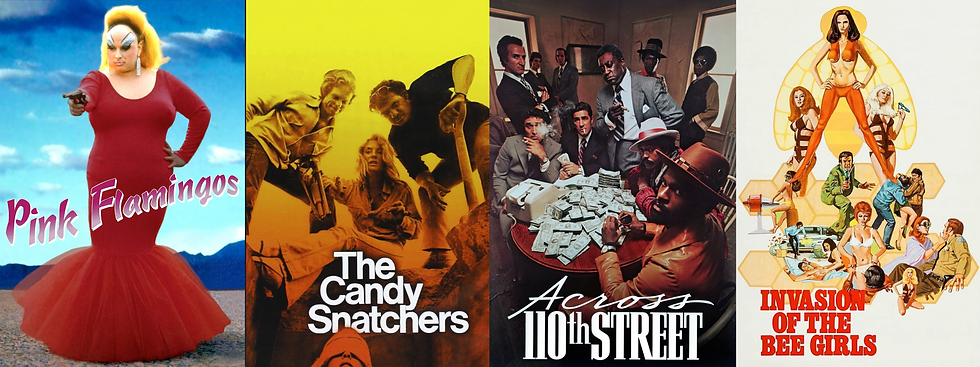
This detachment accelerated through the 1970s with the rise of the exploitation genre:⁶ films such as Death Wish (Winner, 1974), in which Charles Bronson's vigilante enacts fantasies of retribution with a stylistic cleanliness that systematically evacuated any social complexity the premise might have generated. The criminal had become fascinating, a figure onto whom audiences projected not condemnation but identification, not moral distance but desire.
Where neorealism had posed the criminal as an urgent social question — De Sica's protagonist, arrested for theft at the conclusion of Bicycle Thieves, held by the camera in unsparing moral ambiguity, a man broken by a system rather than by character — New Hollywood had processed that question into a genre convention, a narrative pleasure, a commodity. The discomfort neorealism demanded of its audience had become, forty years later, the very source of the entertainment.
Nonetheless, the decade produced alongside its excesses films of extraordinary moral seriousness: Coppola's The Godfather (1972), Scorsese's Taxi Driver (1976), each confronting violence as a symptom of something profound in American life. Nevertheless, the dominant trajectory was unmistakable: Roland Barthes, in S/Z (1970), described the proairetic code⁷ as the chain of actions through which narrative generates momentum. In the cinema of the 1970s, violence had become entirely proairetic — an action whose primary meaning was not ethical but sequential, not social but cinematic. The criminal protagonist does not raise a moral question; he initiates a sequence.
What the Screen Made of the Streets
Neorealism, viewed through the analytical instruments that Barthes bequeaths us, had deployed violence as a transparent sign of social reality. In doing so it inadvertently licensed a process through which that sign would be progressively hollowed of its referent, until violence on screen ceased to signify suffering or systemic failure and became instead a formal language with its own grammar, its own pleasures, its own modes of address.
What the directors of bombed-out postwar Rome could not have foreseen was that the very rawness of their gaze, the camera's willingness to look at suffering without flinching, would eventually be metabolized by a culture industry always seeking the next escalation of sensation, and returned to audiences not as a mirror of reality but as its sophisticated, pleasurable, and deeply ambiguous simulacrum.
Sources & References
¹ The Motion Picture Production Code, commonly known as the Hays Code after its architect Will H. Hays, was a set of moral guidelines applied to films produced by major Hollywood studios. Formally adopted in 1930 and strictly enforced from 1934, it prohibited content deemed immoral or subversive, including graphic violence, sexual frankness, and sympathetic depictions of crime.
² The MPAA rating system, introduced in 1968 under Jack Valenti, replaced the Hays Code with a classification framework — G, M, R, X — that informed audiences about content rather than prohibiting it outright. It remains, in revised form, the standard system used in American cinema today.
³ Italian neorealism was a filmmaking movement that emerged in Italy during and immediately after World War II. Defined by location shooting, non-professional actors, and stories drawn from working-class life, it was a direct response to both the devastation of the war and the artificiality of the studio cinema that preceded it. Its key figures include Roberto Rossellini, Vittorio De Sica, and Luchino Visconti.
⁴ Sight & Sound is a British film magazine published by the British Film Institute, whose decennial poll of critics and filmmakers is widely considered the most authoritative ranking of the greatest films ever made. Bicycle Thieves topped the list in 1952 and 1962.
⁵ Peter Bondanella, Italian Cinema: From Neorealism to the Present (New York: Continuum, 1983). Cesare Zavattini was the screenwriter and chief theorist of Italian neorealism, who argued that cinema should abandon invented plots entirely in favor of the unmediated observation of everyday life.
⁶ Exploitation cinema refers to a category of low-budget films produced from the 1960s through the 1980s that deliberately traded on sensational content — violence, sex, transgression — to draw audiences. The genre operated largely outside the major studio system and was defined by its willingness to go further than mainstream cinema in depicting taboo material.
⁷ Roland Barthes, S/Z (Paris: Éditions du Seuil, 1970; English translation, New York: Hill and Wang, 1974). The proairetic code is one of five narrative codes Barthes identifies in his analysis of a Balzac novella. It refers to the logic of action sequences — the way one event implies and generates the next, creating narrative momentum independently of any deeper meaning.
Commentaires