


Dark Academia : The Genre That Erased Itself
Dernière mise à jour : 13 déc. 2025
Tweed jackets, black coffee, dead languages; a world where beauty justifies crime and longing becomes deadly. Brilliance, obsession – that is the true birth of dark academia.
It all began with a single satiric novel: Donna Tartt’s The Secret History. From a sharp critique of elitist intellectualism, the genre evolved into a shallow internet aesthetic of coffee-stained books and performativity.
Retracing the history of dark academia questions why we romanticise intellect, why we dress like the people we envy, and mostly, how easily a mood can turn into an obsession.
What follows is the story of a genre that keeps slipping away from the meaning it once held.
1992 - The Secret History: The Roots of Obsession
Donna Tartt’s haunting novel would soon become the heart of the most successful occurrence of aesthetics ever created. It all started in 1992: a story about Classics students committing a terrible crime in pursuit of beauty. The novel is a campus murder that refuses to behave like a thriller: it isn’t about what happened but why a group of privileged students believed beauty could justify violence.
‘Death is the mother of beauty.’‘Beauty is terror. Whatever we call beautiful, we quiver before it.’
Donna Tartt, The Secret History
Richard Papen, unreliable narrator, embodies dark academia’s contemporary enthusiasm. A working-class outsider enters an elite Ancient Greek program, stuck between university life and cold nights where ideas are taken too far, and where learning becomes a religion and aesthetics rule his life. His desire to belong slowly turns into an obsession, as he admits:
‘Does such a thing as “the fatal flaw,” that showy dark crack running down the middle of a life, exist outside literature? I used to think it didn't. Now I think it does. And I think that mine is this: a morbid longing for the picturesque at all costs.’
Donna Tartt, The Secret History
The novel lays out all the elements that would define dark academia for decades: the obsession with the Humanities, the queer undertones in complex male friendship, intellect as a tool for the assertion of power, and an elitist society, as seductive as it is exclusive. But it also gave life to an atmosphere. Wool coat, candlelight, and late-night scotch.
Yet beneath the tweed and tragedies lies a brutal truth:
‘There is nothing wrong with the love of Beauty. But Beauty, unless she is wed to something more meaningful, is always superficial.’
Donna Tartt, The Secret History
Dark academia, long before it had a name, was a warning. A warning of the dangers of fetishising genius, of mistaking knowledge for virtue, of believing beauty can excuse anything. But as the novel slipped into the hands of readers who saw themselves in its shadows, the warning faded. The earth tones grew brighter than the violence beneath them. The aesthetic overshadowed the critique.We were supposed to withdraw from that world.
Instead, we fell in love with it.
The 2010s - Tumblr: Rise of Aesthetics
Two decades later, what had once been a novel about elitism and moral decay resurfaced at the heart of the 2010s internet chaos: Tumblr. Before dark academia switched to an aesthetic, it was a fandom. A quiet corner of the internet, where teenagers romanticised studying through collages of curated melancholy and screenshots from Dead Poets Society.
Dead Poets Society, Kill Your Darlings, and The Secret History became the holy trinity of dark academia; they gave the genre its essence online. The first hints of dark academia on Tumblr can be traced back to 2015, and it soon became a niche topic among fans of the book and those movies. It grew into a checklist:
Wear brown, earth tones. Read classics. Drink black coffee, no sugar.Romanticise burnout.Be mysterious and smart.
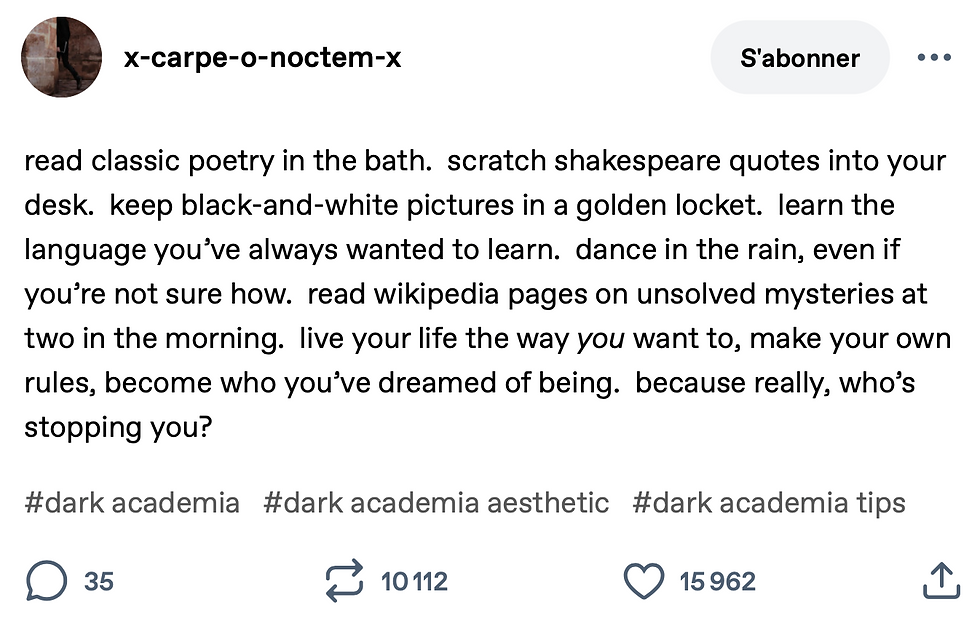
Dark academia could now be worn, and the atmosphere of The Secret History was no longer confined to its pages. The literary backbone slowly thinned out; moodboards started circulating without context.
Think of it as a movie from which you remove dialogues. The beauty was still there, but we were losing the plot.
Because:
‘Any action, in the fullness of time, sinks to nothingness.’
Donna Tartt, The Secret History
2020 and TikTok: When Dark Academia Becomes an Escape
Lockdowns, webcams, suspended campus lives. That is our generation’s collective memory of 2020.
What had once been a fandom became a fantasy of the academic life no one could have. The “dark” in the name now only referred to the aesthetic, completely erasing the themes of murder, obsession, moral decay, and power. It was replaced by desk set-ups and “a day in the life of a Classics student” videos.

‘After all, the appeal to stop being yourself, even for a little while, is very great.’
Donna Tartt, The Secret History
Publishers seized the opportunity: anything vaguely gothic or set in universities was now “dark academia.” Hundreds of books came out marketed as such, blurring the line between what does and does not belong to the genre. To this day, no one can give you a list of dark academia books without being criticised.
Yet among the noise, one novel stood out: R. F. Kuang’s Babel. Unlike the TikTok fantasy, Babel confronted and even elaborated on what had been forgotten: colonialism, linguistic power, and the violence beneath academic prestige. But this was an exception.
Ironically, TikTok stripped away the discomfort that gave the genre its meaning.
2025: The Afterlife of an Aesthetic
What is left of it, then?
Now, dark academia is no longer a subculture — it is a combination of micro-trends built on a shared desire to appear well-read. The palette remains the same (brown, wool turtlenecks, tragic genius), but the ideology is lost. It grew too broad, and the internet broke it down into shallow pseudo-identities.
Dark academia is more than performance: it is a mirror of online anxieties. The pressure to look cultured, the prestige of endless reading lists, the satisfaction of appearing “deep.” We dress like scholars when we fear we aren’t enough; we cling to old-world aesthetics when the present feels unsteady.
Yet, something has returned. Readers now question the elitism the genre once celebrated. Creators discuss its whiteness (here is a list of less Eurocentric dark academia content), its class barriers, and its glamorisation of burnout. The conversation is shifting from performance to purpose, from costume to critique.
It all circles back to its roots. Performance turns into a search for purpose. Critique is welcome.
This retrospective shows how dark academia mirrors our own relationship with intellectual life. Ultimately, it survives because it gives a space for a timeless longing: to be brilliant, to belong, to believe that knowledge makes you greater.
Dark academia matters not because of the coats or candles, but because it reveals a generation desperately clinging to meaning in a culture built on facade.
“I am nothing in my soul if not obsessive.”
Donna Tartt, The Secret History
Commentaires