


Cairo's New Museum Is Gorgeous. It's Also a Double Standard.
Dernière mise à jour : 13 déc. 2025
Anyone who has stood in front of pharaonic artifacts in the Louvre or the British Museum has likely wondered, “How did this end up here?” Two centuries on, the Grand Egyptian Museum (GEM) is taking a long-overdue step to answer that. (But seriously—keep questioning it.) As the doors open to the public for the very first time, a symbolic threshold is crossed: a long-fractured continuity between ancient and modern Egyptian history finally steps into the light.
Cairo, November 1st, 2025. After a century of displacement, Tutankhamun and his entire funerary collection have finally come home. Safe and sound, warm and almost drowsy under the Egyptian sun, the treasures of the Boy King now rest inside the long-awaited Grand Egyptian Museum.

Egyptian heritage: a longtime shared meal for the Western appetite

For decades, Egypt’s past has been consumed elsewhere. Between colonial extraction, dubious purchase, and plunder, Egyptian artifacts have spent more time traveling than many modern tourists; circulating between London, Paris, Berlin, and beyond, often stripped of the landscapes, rituals, and languages that gave them meaning.
Decontextualized and rebranded as “universal heritage,” they were implanted in foreign galleries with a narrative that insisted they somehow belonged to everyone, and therefore to no one. This argument resurfaced most loudly whenever Egypt demanded the return of major objects: the Rosetta Stone from the British Museum, the bust of Nefertiti from Berlin’s Neues Museum. The defense was always the same: these institutions claimed to serve a global audience, and insisted that “developing countries” lacked the infrastructure to preserve their own heritage. In other words, the West behaved like that overprotective mom who refuses to hand back your car, not because it’s unsafe, but because clearly you’re too reckless to own it. Except Egyptian heritage isn’t a car, and no matter how long they hold the keys, history eventually drives itself home.
Today’s opening of the GEM is more than a museum inauguration. It marks Egypt’s patient, determined effort to put an end to a long era of intrusive physical and intellectual displacement; an era in which its own history could be admired everywhere except where it was born.
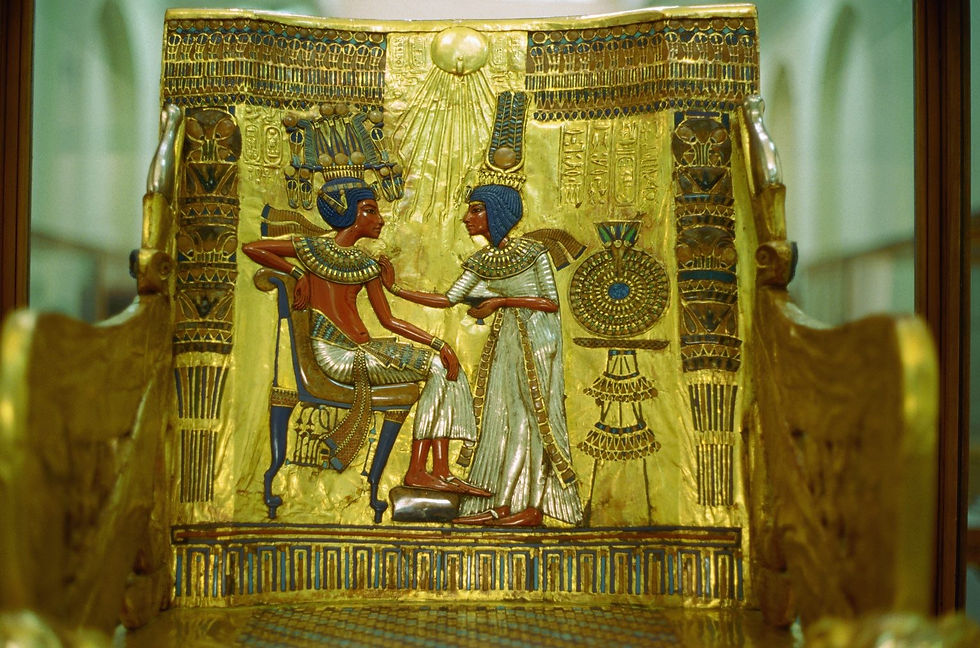
It stands as a decolonial movement in the museum world, and it’s not new. Greece launched its long-running campaign for the return of the Parthenon Marbles as early as the 1980s, notably when Culture Minister Melina Mercouri addressed UNESCO in 1982 to demand their return. Meanwhile, Nigeria’s call for restitution of the Benin Bronzes goes back decades. The federal government formally demanded their repatriation in March 2002.
This repatriation trend is a double win for source nations: first, it strengthens their claim to sovereignty over their cultural heritage, as it challenges the moral legitimacy of Western curating institutions; second, it bolsters their diplomatic credibility. Housing one of the world’s richest histories is not just a matter of pride; it's a powerful bargaining chip. For too long, these nations lacked equal footing in global negotiations. Today, reclaiming their physical and intellectual heritage is rewriting that balance.
THE SUDANESE PARADOX: DECOLONIZE TO COLONIZE?
Reproducing Colonial Patterns, But Locally This Time
Here’s where the narrative becomes a little too… inconvenient. While the global spotlight gushes over Egypt’s pharaonic grandeur, it actively overshadows the country’s African connection and the historical claims of its southern neighbors. In all the coverage of the GEM's opening, the breathless tours of Tutankhamun's 5,398 treasures, the display of Khufu's solar boat, the shiny halls celebrating pharaonic kingship, specific Nubian artifacts are conspicuously absent from the conversation. The silence is deafening. And yet, the new GEM openly displays a civilization that once stretched from southern Egypt into northern Sudan.
I know what you're thinking: Ancient Nubia? Where exactly? Well, today most of that ancient kingdom, including its people, its heritage, its surviving memory, lies in Sudan, not Egypt. And no, Sudan is not some “side-character” in the story. During the 25th Dynasty (circa 744–656 BCE), Nubian and Kushite kings ruled the entire Nile Valley, including Egypt. Yes, Sudan once ran the neighborhood. Surprising? Apparently so.

Now imagine the following: your country once stood as a major regional power. But in the 20th century, you woke up unable to exercise cultural sovereignty over your own heritage because a Soviet engineer named Nikolai Aleksandrovich Malyshev designed the Aswan High Dam in 1960, triggering a massive flood, displacing communities, and throwing centuries of Nubian heritage into existential danger.
The international "rescue" mission that followed (UNESCO's 1960–1980 International Campaign to Save the Monuments of Nubia) was genuinely necessary. The flooding was imminent and catastrophic. Tens of thousands of Nubians, both Egyptian and Sudanese, were forcibly displaced from their ancestral lands between 1963 and 1965. Egypt relocated its Nubian population to Kom Ombo, 30 miles north of Aswan, while Sudan moved its communities hundreds of miles southeast to Khashm el-Girba on the Atbara River.
Temples such as Abu Simbel were “saved” (which is museum-speak for “concentrated in Egypt or handed out to foreign galleries as diplomatic souvenirs”). What they weren’t, however, was returned to their native authors.
And here comes the double standard: Egypt’s fierce critique of Western museums reproduces, almost perfectly, the very colonial patterns it condemns. Sudan simply doesn’t benefit from the same international attention, funding, or preservation infrastructure that Egypt enjoys. Result: a deeply asymmetrical cultural hierarchy that mirrors the colonial one, except this time it’s regional.

So let’s run the checklist:
Appropriation of culture and territory, check.
Exploiting resource asymmetry, check.
Controlling mainstream narratives, check.
Displacement with zero restitution, check.
And just like that, you’ve earned your new colonial badge.
Toward True Decolonization: The Warning Within The Victory
True decolonization is more than retrieving artifacts from Western gatekeepers or stamping your mark on a national museum. It requires decolonizing the mind and challenging the idea that integrity is measured by how loudly you can impose, command, respect, or flaunt global power.
So, is Egypt ready to collaborate with Sudan on their shared Nubian legacy? Will it give Nubian voices the space to lead exhibitions and tell their own story? I’m not the one to answer that, but if nationalism and political ego continue to prevail, this moment risks ending before it truly begins.
The Grand Egyptian Museum is both a victory and a warning. It embodies the spirit of cultural resistance while flirting with the same temptation it claims to condemn: cultural imperialism. The question isn’t whether Egypt deserves this institution; of course, it does. But distorted and selective restitution remains exactly that: distorted and selective. It still decides who gets to narrate history and who profits from it.
And here’s the kicker: the debate isn’t just West versus non-West. It plays out within the postcolonial world itself.
Moral of the story: don’t be the gatekeeper. Especially not after you've just escaped being gated yourself.
Commentaires